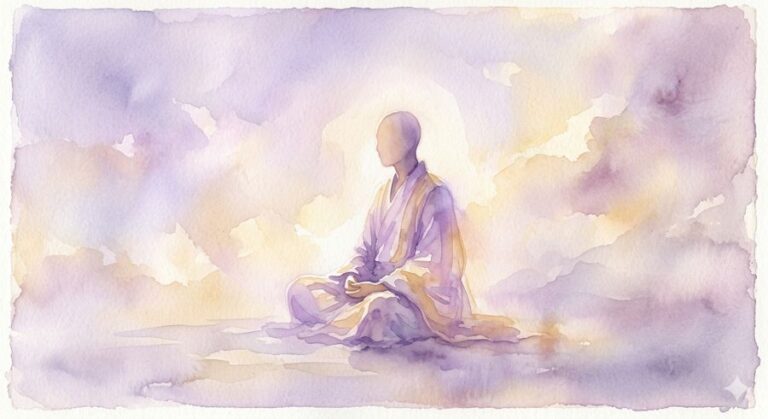
After enough sessions, a practitioner starts to notice patterns that are not in any textbook. One of the ones I find most interesting, and most quietly important, is what I have come to call the inner quiet. It is the particular hush that arrives at a specific point in almost every deep session, regardless of who the client is or what they came in for. It does not always last long. But when it arrives, something becomes possible that was not possible before.
- Around an hour into deep trance, a distinct settling appears in almost every client, quieter than the initial relaxation
- This inner quiet is recognisable by small external signs: slower breathing, a change in facial softness, a stillness in the hands
- The material that emerges after this point is reliably different in tone from what came before
- Clients often describe the inner quiet afterwards as feeling more like themselves than ordinary waking life does
- The pattern is so consistent across sessions that I have come to use it as a marker for when to shift how I am holding the space
Where the quiet arrives
A QHHT session in my Laren practice begins with an induction and moves through relaxation into what Dolores Cannon called the somnambulistic state. That initial descent takes roughly thirty to forty minutes. It is already deep, already productive, already capable of significant material. But something else happens, later, that I began to notice only after I had done enough sessions to stop looking for it.
Somewhere around the sixty minute mark of deep work, the client settles again. The breathing slows a second time. The shoulders drop a second time. There is a softness in the face that was not quite there before. It is not a loss of alertness. The client often speaks more clearly after this point, not less. But the quality of the speaking is different, and what they describe begins to come from a different layer.
Why I think this happens
In my experience, what arrives at this moment is the letting go of something the client had been carrying without knowing. The initial relaxation phase releases obvious holding patterns: the tension of arrival, the residue of the morning, the effort of entering trance. The later settling releases something older. It is not specific to the session’s content. It seems to be a layer of low-level holding that adults carry through ordinary life, and that only lets go once the body has been at rest for long enough.
Something I often see is that clients describe feeling, at this point, more like themselves than they have in years. This phrasing is almost identical from one client to another, which is how I know it is pointing to something real. The inner quiet is not an unusual state. It is closer to the state underneath the usual state, and the absence of holding makes it recognisable as more familiar, not less. I have written about the voice that often emerges from this layer.
What the quiet makes possible
Before the inner quiet arrives, clients can reach significant material, but the material often carries traces of the effort that reached it. It comes with a little tension, a little urgency, a little performance. After the inner quiet arrives, the same material, or different material, comes with a different quality. There is no push behind it. It simply surfaces.
This is the phase in which the Higher Self tends to come forward most easily. It is not that the Higher Self was unavailable before. It is that the client is now more available to hear it. The conversation opens, and both the tone and the content shift. I have written about this voice as Dolores described it.
How I work with it
When I recognise the inner quiet arriving in a client, I change how I am holding the room. I speak less. I ask fewer leading questions. I allow longer silences. The temptation, especially for newer practitioners, is to keep the session moving, to keep asking, to keep guiding. The inner quiet is often the moment to stop guiding and let the client be the one leading. The Higher Self knows what it wants to say, and my job at that point is to stay out of the way.
In my experience, clients who are given enough silence at this point bring forward material that no question could have reached. The silence itself invites the deeper layer. A well-held silence, the kind that does not feel empty, is one of the most sophisticated instruments a practitioner has. Dolores was firm about this in her teaching, and it has been confirmed for me session after session. I have written about this knowing that the quiet makes available.
When the quiet does not arrive
Not every session reaches this phase. Some clients, particularly those newer to deep relaxation or those carrying a high background load of stress, do not settle into it in their first visit. The session can still be useful. The initial depth alone produces real insight. But the quality of material that becomes available later, once the inner quiet has arrived, is worth knowing about. Clients who did not reach it in one visit sometimes return a year later and reach it more easily, simply because their nervous system remembers the path.
Something I notice is that clients who come back for a second session settle into the inner quiet much earlier the second time. The body learns. This is one of several reasons the integration weeks after a session matter as much as the session itself. I have written about those weeks.
What the quiet is not
It is worth being careful here. The inner quiet is not a mystical state. It is not a level of attainment. It is not something only certain clients can reach. It is a layer of the nervous system that adults carry and that softens when given enough time in a well-held space. Naming it makes it sound more special than it is. What is actually special is how often we do not visit this layer in ordinary life, and how much becomes visible when we do.
For clients arriving at my practice in Het Gooi for the first time, the inner quiet is not something to aim for. The aim is simply to show up, to settle, to give the session enough time. If the inner quiet arrives, it arrives. If it does not, it often arrives the next time. Either way, the method respects the body’s pace, and the body, once it is trusted, usually finds its own way toward the quiet that was always available underneath.