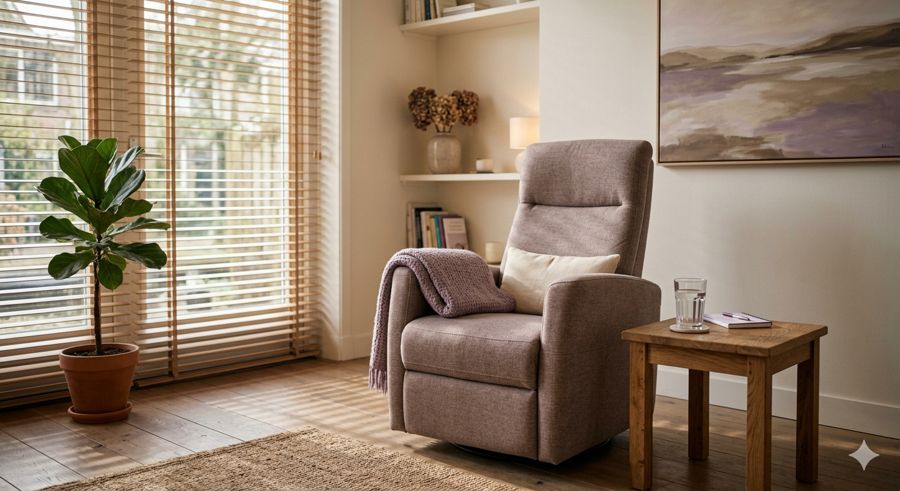
The blinds are half drawn. There is a recliner in the center of the room, angled slightly away from the window so the afternoon light falls across the floor without reaching anyone’s face. A glass of water sits on the side table. The recording device is already running. And the person lying down has just closed their eyes.
- The atmosphere of the room changes measurably as a client enters deep relaxation
- Practitioners learn to read the room as much as they read the client
- Silence during a session is not empty but full of information
- The physical environment plays a larger role in the depth of the experience than most people realize
Before the First Word
I set up the room the same way every time. It is a small, deliberate ritual that has nothing to do with superstition and everything to do with signaling safety. The temperature is set slightly warm. There is no music, no incense, nothing that announces “this is a spiritual experience.” My practice in Laren is in a quiet residential area, and the only sounds that sometimes drift in are birds and the occasional car passing on the lane outside.
This matters more than people think. Research on environmental psychology has consistently shown that physical surroundings directly influence the nervous system’s ability to shift from sympathetic (alert) to parasympathetic (rest) activation. A person cannot enter the somnambulistic state if their body is registering even subtle environmental threats. This is part of why I chose Laren over a busier location closer to central Amsterdam. The quiet is not a luxury. It is a clinical requirement.
The Sound of Someone Letting Go
There is a specific sound that marks the transition. It is not dramatic. It is a single, long exhale that comes from somewhere deeper than normal breathing. The diaphragm drops. The shoulders, which had been carrying the weight of the conversation we just finished, finally settle into the recliner.
I have guided hundreds of sessions, and this exhale still stops me every time. Not because it is surprising, but because it is so consistent. The body has its own way of announcing that the conscious mind is stepping aside. After that exhale, the quality of the room shifts. The air feels thicker. Not in an uncomfortable way, but in the way a room feels different during a thunderstorm or late at night when the rest of the house is asleep.
Clients who come from Amsterdam, often arriving with the residual pace of the city still in their nervous system, sometimes take longer to reach this point. I never rush it. The room holds space for however long that transition needs.
What Silence Actually Sounds Like
People assume that the quiet parts of a session are pauses. They are not. They are some of the most active moments.
When someone goes silent in the middle of describing a scene, something is happening internally that they cannot yet articulate. Their eyes move behind closed lids. Sometimes the muscles around the mouth twitch, as though words are forming and dissolving before they reach the surface. I have learned to wait through these silences completely. Not to prompt, not to redirect, just to be present and let the subconscious work at its own pace.
One thing that still surprises me is how the body communicates during these silences. Hands open. Feet rotate outward. The breathing pattern changes in ways that correspond to whatever internal experience is unfolding. I have started keeping notes on these physical patterns, and they are remarkably consistent across different clients facing similar emotional material.
The Middle of the Session
There is a point, usually about ninety minutes into the hypnosis portion, where the room reaches a kind of equilibrium. The client is deep. Their voice, if they are speaking, has a quality that is hard to describe to anyone who has not heard it. It is their voice, but slower, more deliberate, as though each word is being chosen by something that takes language very seriously.
This is typically when the Higher Self portion begins. And the room knows it. I realize that sounds abstract, but after enough sessions in the same space, you develop a sensitivity to shifts that have no measurable explanation. The light does not change. The temperature does not change. But something in the room becomes very still in a way that feels intentional.
Colleagues who practice other forms of hypnotherapy in the Amsterdam area have told me they experience something similar. It appears to be a recognized phenomenon among practitioners who work at depth, even if no one has published a paper on it yet.
Coming Back
The return is always gentle. I count slowly, and the person begins to surface at their own pace. Some take thirty seconds. Some take several minutes. The first thing most people do is open their eyes and look around the room as though they are seeing it for the first time.
This is the moment I enjoy most. Not because the session is over, but because of what I see in their face. There is usually a softness there that was not present when they arrived. Something has been met, acknowledged, or released, and the body knows it even if the mind has not caught up yet.
Then we sit together for a while. Sometimes we talk about what happened. Sometimes we do not. The glass of water gets picked up. The afternoon light has moved across the floor. And the room slowly returns to being just a room again.