People who find their way to my practice in Laren have usually already looked into other options. They have read about clinical hypnotherapy, perhaps tried a session or two elsewhere, and something brought them here instead. When I ask what made them curious about QHHT specifically, the answer is almost always some version of the same thing: “I felt like the other approach was not going deep enough.”
- Traditional hypnotherapy typically works through suggestion while QHHT works through self discovery
- QHHT sessions are significantly longer because they access a deeper level of trance
- The practitioner does not direct the healing; the client’s own subconscious does
- Both approaches have value, but they serve different needs at different stages
The Core Difference
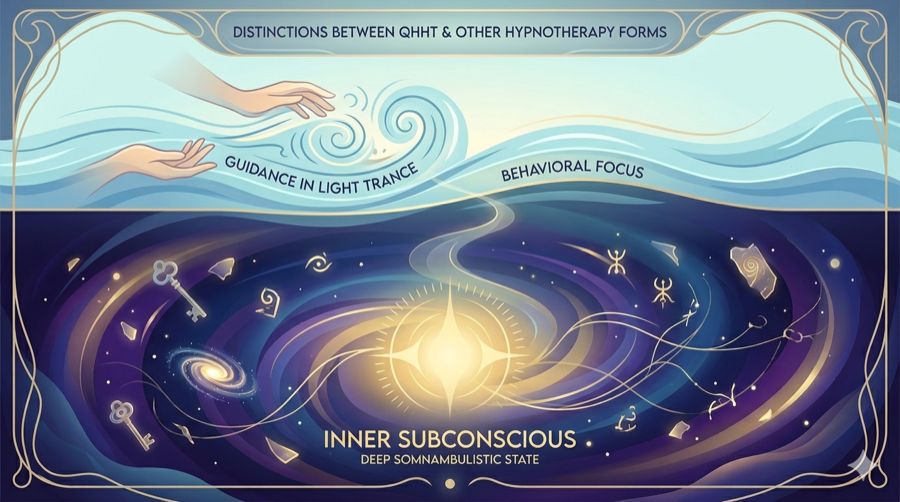
Most forms of hypnotherapy in Amsterdam and the Netherlands work in a light to medium trance state. The therapist uses carefully crafted suggestions to help shift behavior patterns, reduce anxiety, or change habits. This is effective for many people, and I have genuine respect for practitioners who do this work well.
QHHT operates differently. Instead of guiding the client toward a specific outcome, the practitioner facilitates access to the somnambulistic state, the deepest level of trance before sleep. In this state, the client’s own subconscious leads the process. It chooses what to show, what to address, and what to heal. The technique was developed over decades by Dolores Cannon, who discovered that this depth of trance allows a quality of insight that lighter states simply cannot reach.
Something I have come to appreciate after years of practice is that neither approach is inherently better. They answer different questions. If someone wants to stop smoking, suggestion based hypnotherapy might be the more direct path. If someone wants to understand why they have carried a particular fear since childhood, or why they keep finding themselves in the same relational pattern despite knowing better, that is where QHHT tends to reach further.
What a Session Actually Looks Like
A standard hypnotherapy session in the Amsterdam area typically lasts between sixty and ninety minutes. A QHHT session takes four to six hours. That difference alone tells you something about the depth of the work.
The first portion is an extended conversation. Not a clinical intake, but a real dialogue about your life, your patterns, and the questions you have been carrying. This conversation is not separate from the session. It is part of it. The things you share help shape what the subconscious brings forward later.
Then comes the hypnosis itself, where you are guided into a deep regression experience. This might involve past life scenes, symbolic imagery, or childhood memories. After that, the practitioner connects with the deeper part of your awareness to ask your prepared questions and explore healing.
Clients who have experienced both approaches often tell me that traditional hypnotherapy felt like being guided, while QHHT felt like being shown something by a part of themselves they did not know they could access.
Who Each Approach Serves Best
There is a pattern I notice with people who come to Laren from across the Netherlands and sometimes from other countries. They tend to be at a particular stage in their inner work. They have often already done therapy, meditation, or other forms of personal development. They are not beginners. They are people who have done the surface work and sense there is something underneath that they have not been able to reach yet.
Traditional hypnotherapy serves well when the goal is specific and behavioral: managing stress, improving sleep, building confidence, addressing phobias. It works within the framework of the conscious mind’s goals.
QHHT serves well when the questions are deeper and less defined: why do I feel this way, what am I not seeing, what is the root of this pattern that logic alone cannot explain. It works by stepping outside the conscious mind’s framework entirely and letting something deeper take the lead.
An Honest Consideration
I want to be straightforward about something. QHHT is not for everyone, and I do not think it should be. If you are looking for a quick, targeted intervention, a skilled hypnotherapist in Amsterdam who works with suggestion based methods will likely serve you better. If you are looking for understanding why certain things persist despite your best efforts to change them, and you are willing to spend an entire day on the process, then QHHT offers something that most other modalities do not.
The fact that you are reading this and comparing options is itself a meaningful signal. Most people who end up in a QHHT session spent time exactly where you are now, weighing whether this particular form of exploration is the right next step. There is no rush to decide. The work will be there when you are ready for it.