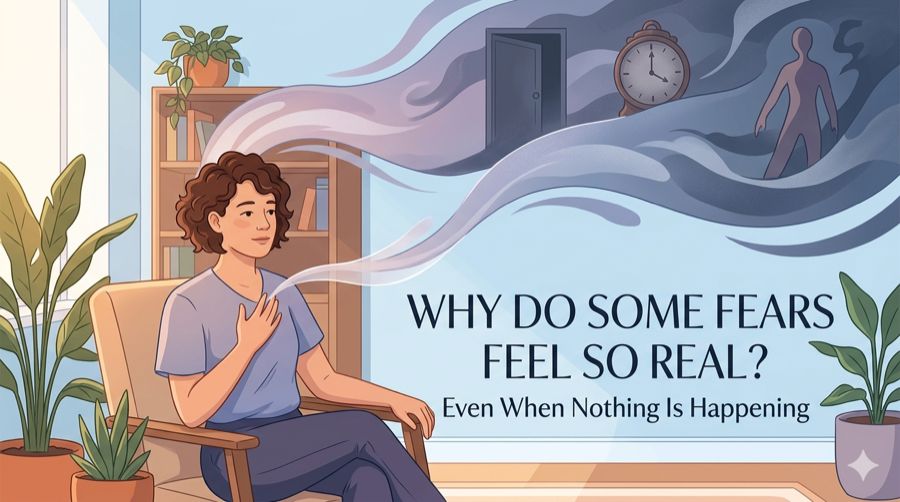
There are moments when fear appears without a clear reason. You might be sitting in a calm environment, everything seems fine, yet your body reacts as if something is wrong. Your thoughts start to race, your chest feels tight, and a sense of unease takes over. What makes it even more confusing is that you cannot always point to a specific cause.
- The subconscious does not separate past from present clearly
- Stored memories can trigger physical responses without a visible cause
- Understanding the origin of fear reduces its intensity
- Deeper exploration helps the mind reorganize what it has been holding
When the Present Moment Is Not the Problem
Most people try to deal with this by focusing on the present moment. They tell themselves that everything is okay, that there is no real danger. While this can help temporarily, it does not always reach the root of the experience. Because in many cases, the feeling is not coming from what is happening now. It is coming from something that has already been stored in the mind.
The subconscious mind does not operate in the same way as the conscious mind. It does not separate past and present as clearly. When it recognizes something familiar, even in a subtle way, it can trigger a response that feels immediate and intense. Research on fear conditioning shows that the amygdala can activate a threat response based on partial pattern matches, meaning a sound, a smell, or even a quality of light can trigger a reaction linked to an experience stored years or decades ago. This is why certain fears feel so real, even when there is no logical explanation for them in the current moment.
Going Beneath the Reaction
This understanding has led many people to explore approaches like anxiety hypnosis, not just to calm the feeling, but to understand where it comes from. Instead of trying to suppress the reaction, the focus shifts toward gently accessing the deeper layer where the response was first created. When that connection becomes visible, the fear often begins to lose some of its intensity.
In my practice in Laren, I have worked with clients who carried specific fears for decades without understanding their origin. One woman had an intense fear of enclosed spaces that no cognitive therapy had resolved. During her session, the subconscious brought forward a scene, whether literal or symbolic, that gave her a framework for understanding where the reaction originated. The fear did not vanish overnight, but within weeks she noticed that her chest no longer tightened in situations that would have previously triggered panic.
What Regression Reveals About Fear
In some cases, people discover that their reactions are linked to earlier life experiences that were never fully processed. In other situations, deeper exploration methods such as regression work can bring forward impressions that feel symbolic but meaningful. These experiences do not need to be taken literally to be useful. What matters is the clarity they bring and the way they help the mind reorganize what it has been holding onto.
This is also why interest in hypnotherapy in Amsterdam continues to grow. People are no longer only looking for ways to manage symptoms. They are becoming more interested in understanding themselves at a deeper level. They want to know why they feel the way they do, not just how to make it stop.
From Fighting to Understanding
For those who take this path, the experience is often different from what they expect. It is not about losing control or being influenced from the outside. It is more about creating a space where the mind can reveal what it already knows. In that space, patterns become clearer, and reactions that once felt automatic begin to shift naturally.
Fear does not always need to be fought. Sometimes it needs to be understood. And when it is understood, even partially, it often changes in ways that feel both subtle and meaningful.