There is a question I hear more than almost any other. People sit across from me in my practice in Laren, just a short train ride from Amsterdam, and they ask it in slightly different ways each time. But the core is always the same: what will it actually feel like?
- Past life regression feels less like watching a movie and more like remembering something you forgot you knew
- Emotions often arrive before images, and the body responds before the mind catches up
- The experience is different for each person, but a sense of familiarity is almost universal
- What matters most is not whether the experience is literal, but what it reveals about the present
The Moment It Begins
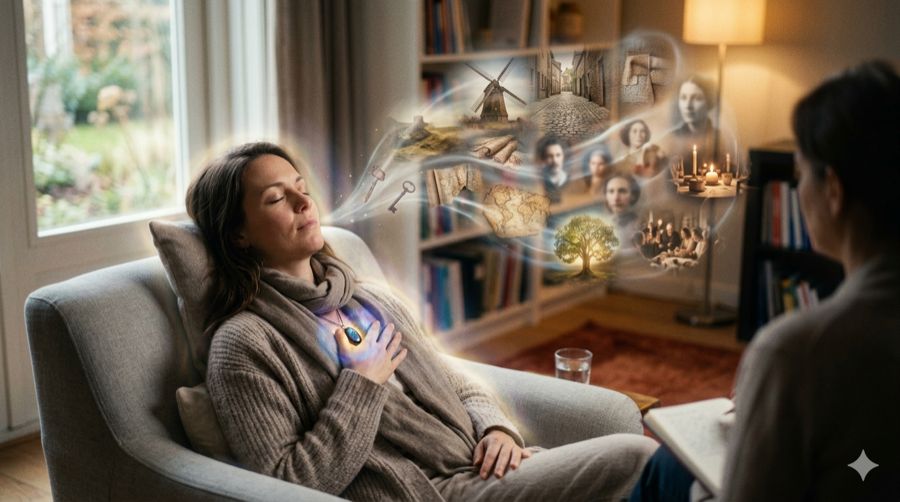
Something I often notice is that the transition happens more gently than people expect. There is no sudden drop or dramatic shift. The room stays the same. My voice stays the same. But somewhere in the middle of a long, slow exhale, the person on the recliner begins to describe something they are not imagining on purpose. A color. A texture. A feeling in their hands. It often starts with the body rather than the mind.
In my experience working with clients near Amsterdam, the ones who arrive with the fewest expectations tend to have the most vivid sessions. The mind does not need to be convinced. It needs to be quiet enough for something else to come through.
What People Actually See and Feel
There is a common assumption that past life regression looks like a film playing behind your eyes. Some people do experience it that way. But more often, it is closer to remembering a dream. Fragments arrive out of order. A face you recognize but cannot name. A landscape that feels like home even though you have never been there.
Clients sometimes tell me they felt the temperature of the air in the scene, or noticed the weight of clothing on their body, before they could see anything clearly. The emotional layer often arrives first, and the visual details fill in around it.
One pattern I have observed over many sessions is that the subconscious does not show random scenes. It consistently brings forward experiences that connect to something the person is currently navigating in their life. A client dealing with a fear of abandonment might find themselves in a scene where loss is central. Someone struggling with self expression might experience a life where speaking was dangerous. The connections are rarely obvious at first, but they become clear as the session unfolds.
The Role of the Subconscious
Whether these experiences represent actual previous lifetimes or symbolic narratives created by the subconscious is a question each person answers for themselves. From a practitioner’s perspective, what matters is the result. When someone sees the origin of a pattern, even symbolically, the pattern itself begins to loosen.
This is closely related to how a full QHHT session unfolds. The regression is not an isolated event. It is part of a larger conversation between the conscious and subconscious mind. The technique, originally developed by Dolores Cannon, was specifically designed to access this deeper level of awareness.
Something that continues to surprise me, even after years of practice here in the Amsterdam area, is how specific the subconscious can be. It does not deal in vague metaphors. It shows precise scenes, with details that carry meaning the conscious mind would never have assembled on its own.
After the Scene Fades
When the regression portion of a session ends, most people need a moment to reorient. The room feels slightly different. Time has moved in a way that does not match what they expected. Three hours might feel like forty minutes.
The days following a session are often where the real integration happens. Clients report noticing connections they missed during the session itself. A detail that seemed unimportant suddenly makes sense in the context of their daily life. This is why I always recommend giving yourself space after a session, something I wrote about in more detail in what happens after a QHHT session.
There is a particular kind of quiet that people carry with them after a regression. It is not emptiness. It is more like the stillness after a long conversation where everything important has finally been said.
Not Everyone Sees Past Lives
I want to be honest about this because it matters. Not every session produces vivid past life scenes. Some people experience childhood memories instead. Others encounter symbolic imagery that does not fit any recognizable time period. A few experience pure emotion without any visual content at all.
None of these outcomes are failures. The subconscious shows what is most relevant, and relevance does not always come in the form we expect. For anyone considering this work, whether through past life regression in the Netherlands or elsewhere, the most helpful mindset is curiosity without attachment to a specific outcome.
If you have been feeling a quiet shift and wondering where it is leading, this kind of exploration might be the next natural step. Not because it promises answers, but because it creates a space where answers can arrive on their own terms.