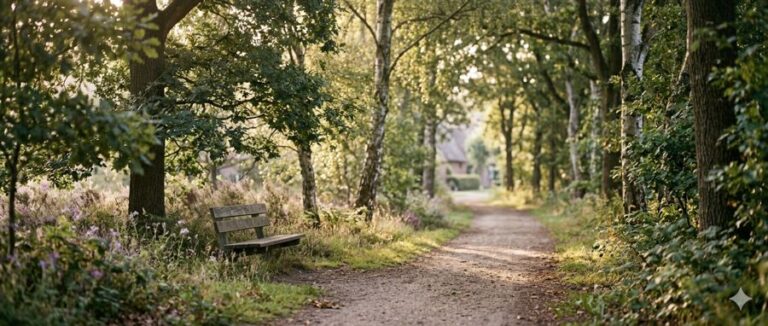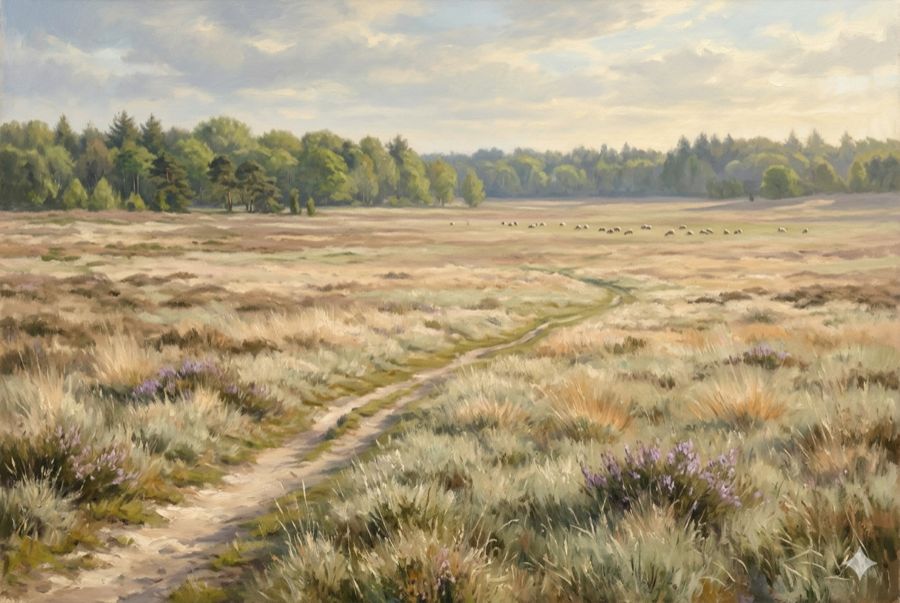
There is a particular quality to the light in Het Gooi on a weekday afternoon. It is the kind of light that does not rush, that slants long over the heather and the low birch and the sandy paths that thread between them. People come to Laren for a QHHT session, and they sometimes ask me afterwards why the environment here feels the way it does. The honest answer is that the land has been doing part of the work for a long time before we ever sit down together.
- Het Gooi is a quiet, forested region east of Amsterdam that includes Laren, Hilversum, Blaricum, and Naarden
- The land is characterised by heather moors, sand drifts, old estates, and patches of deciduous and pine forest
- Its relative stillness comes partly from conservation, partly from geography, and partly from a long cultural association with slow, contemplative living
- Clients often describe a shift in nervous system tone simply from spending an afternoon walking through it
- The practice I run in Laren is surrounded by this landscape, and the landscape quietly participates in every session
The shape of the land
Het Gooi sits on sandy soil that was pushed here by glaciers during the last ice age. That history is visible in its contours. Low, open heathland alternates with thick woodland, and old sand drifts rise unexpectedly in the middle of otherwise flat fields. The area includes several nature reserves, most of them small enough to walk across in an afternoon. Tafelberg, Blaricummerheide, Laarder Wasmeren. These names do not mean much to visitors at first, but by the end of a day spent in them, something in the body remembers them.
Something I often see is that clients who arrive in Laren by car, having driven through the A1 corridor, take longer to settle than clients who have walked at least part of the way. There is a reason for this. The body reads the landscape. When the landscape is still, the body slows with it.
A culture of quiet
Laren itself has been known for centuries as a village where artists and writers retreated. The Larense School of painters worked here in the late nineteenth century, drawn by the particular silver quality of the light and the unhurried pace of the village. The association with contemplative work is older than most people realise. The Singer Museum still holds many of these artists’ paintings and is worth visiting if you are staying in the area.
What I notice in my practice is that this cultural residue has not fully gone away. Clients walking through the centre of Laren before a session sometimes describe it as feeling more like a village in another country than a twenty-minute drive from Amsterdam. The pace is different. The conversations are different. The light, if you pay attention, falls more slowly.
Why the land supports the work
Deep hypnosis requires the nervous system to be willing to lower its guard. That willingness cannot be forced. What can happen, though, is that the environment gives permission. Something about walking under an old oak, or watching heather ripple in a light wind, tells the body that there is nothing urgent nearby. Once the body believes that, the mind follows.
In my experience, this is why clients who have walked for twenty minutes in the woods near my practice before their session settle more quickly once we begin. Their nervous system has already done half the work. I have described what the practice room itself feels like elsewhere. But the room sits inside Het Gooi, and Het Gooi is part of why it feels the way it does.
An afternoon before or after a session
When clients ask how to spend the time around their session, I usually suggest an afternoon outside. Before the session, a slow walk through one of the small reserves is ideal, even fifteen minutes. After the session, something gentler: sitting on a bench near the old windmill in Laren, or lingering over a tea on a terrace in the village centre. A good overview of what to see locally is kept by the regional tourism site for Het Gooi.
What I have noticed across hundreds of sessions is that the clients who give themselves an unhurried afternoon on either side of the session tend to integrate the work more easily. They also tend to return a year or two later for follow-up sessions, because the memory of the whole experience carries the softness of the place with it. The hours that follow a session shape the long-term effect as much as the session itself, and Het Gooi is a particularly gentle place to spend those hours.
A land that asks nothing
Perhaps the simplest thing I can say about this landscape is that it asks nothing of you. You do not need to be anywhere. You do not need to know anything. You do not need to be improving or healing or working on yourself. You can simply walk, and the land accompanies you without commentary. For people arriving from cities, from demanding jobs, from loud inner lives, that absence of demand is a form of medicine in itself.
Clients sometimes tell me, months after a session, that it was not only the session they remember. It was the afternoon around it. The heather, the long shadows, the slowness of a village that has been slow for a very long time. Het Gooi does not announce itself. It waits. And in that waiting, the mind finds its way toward the kind of quiet where real work becomes possible.