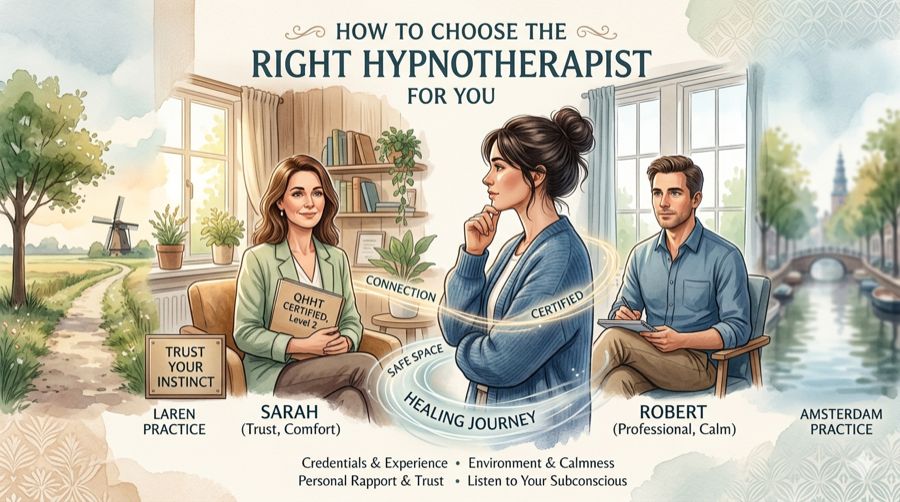
Finding a hypnotherapist can feel overwhelming. There are dozens of techniques, different levels of certification, and very little clarity about what actually matters when choosing someone to guide you into such a personal experience. When potential clients reach out to my practice in Laren, many of them tell me they spent weeks searching before making contact.
The right fit matters more than most people realize. A session only works as deep as the trust between practitioner and client allows.
- Look for specific training and certification, not just general hypnotherapy credentials.
- Trust your instinct when you first speak with a practitioner.
- Ask about their approach to the subconscious and how they handle emotional responses.
- A good practitioner makes you feel safe before the session even begins.
Certification Tells You Where They Trained
Not all hypnotherapy training is equal. Some certifications require hundreds of hours of supervised practice, while others can be earned in a weekend. For QHHT specifically, the training developed by Dolores Cannon has two levels, and the difference between them is significant. A Level 2 practitioner has not only completed the full training but has also demonstrated a consistent ability to guide clients into the somnambulistic state, the deepest level of hypnosis.
When I completed my Level 2 certification, the thing that changed most was not technique. It was confidence. Knowing that I had practiced enough to trust the process, even when sessions took unexpected turns. That kind of readiness is something clients can feel.
The First Conversation Reveals a Lot
I always recommend having a real conversation with any practitioner before booking. Not an intake form, not an automated email. A conversation. The way someone listens, the questions they ask, the space they hold for your uncertainty: these all reflect how they will be during the session itself.
In my practice near Amsterdam, I spend time on the phone or over video with every new client before we schedule anything. It is not a sales call. It is the beginning of the therapeutic relationship. If something feels off during that conversation, pay attention. Your subconscious is already evaluating the situation, much like your body sometimes knows before your mind does.
Ask How They Work With Emotions
Deep hypnotherapy often brings up strong emotions. A practitioner who is uncomfortable with tears, silence, or confusion will limit how far the session can go. Ask them directly: what happens when a client becomes emotional? How do you handle unexpected material?
The answer should feel grounded, not rehearsed. A practitioner who has sat with clients through emotional release many times will speak about it with calm familiarity. Someone newer to the work might give a textbook answer. Neither is wrong, but it helps to know what you are choosing.
Location and Environment Matter
The physical space where a session happens is part of the experience. Some people prefer the energy of a large city, while others find it easier to relax in a quieter setting. My practice is in Laren, a calm town about thirty minutes from Amsterdam, and many clients tell me that stepping out of the urban pace helps them arrive in a more open state.
Think about what kind of environment supports your ability to feel prepared and at ease. The session starts long before you close your eyes.
Trust What You Feel
Credentials, experience, and reviews all matter. But the single most reliable signal is how you feel when you interact with someone. If a practitioner makes you feel heard and unhurried, that is worth more than any certificate on the wall. If something feels rushed or generic, keep looking.
The clients who get the most from their sessions are usually the ones who took the time to find the right person. That search is not a delay. It is already part of the healing.