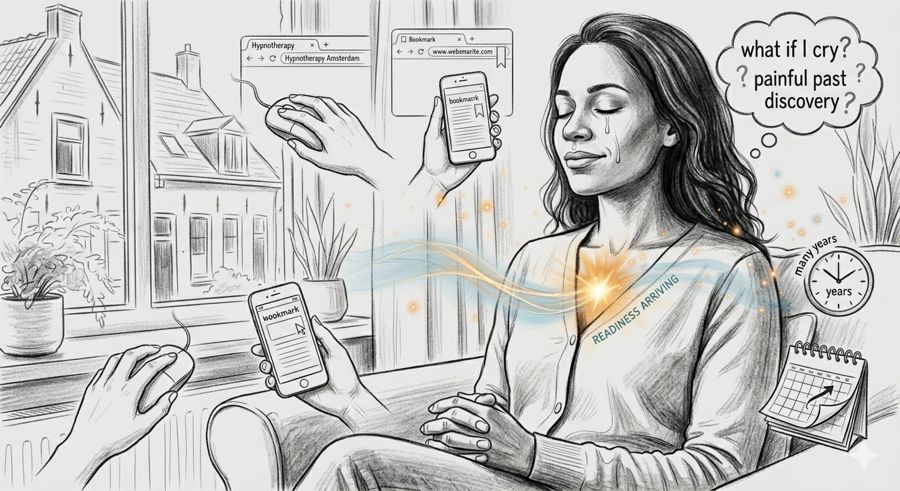
Most people do not book on the day they first hear about this work. They read an article, close the tab, and return to it weeks later. Then months. I know this because clients tell me. Some have had my website bookmarked for over a year before they finally reached out. When I ask what changed, the answer is rarely about finding more information. It is usually something simpler: “I just felt ready.”
- The delay before booking is almost never about doubt, it is about readiness
- Fear of what might surface is more common than fear of hypnosis itself
- People often wait until familiar coping strategies stop working
- The decision to begin usually arrives quietly, not dramatically
The Hesitation That Is Not Really Skepticism
When someone has been considering hypnotherapy in Amsterdam for a long time without booking, the reason they give is usually practical. They say they have been busy, or the timing was not right, or they wanted to do more research first. These are real reasons, but they are rarely the whole story.
What I have noticed in my practice in Laren is that underneath the practical explanations, there is often a quieter concern: what if I find something I am not ready to see? This is not an irrational fear. It is actually a sign of intelligence. The person intuitively understands that this work goes deeper than surface level conversation, and some part of them is checking whether they are prepared for that depth.
The interesting thing is that this protective hesitation tends to resolve itself. Not through convincing or persuading, but through an internal shift that happens on its own timeline. One day the person wakes up and the resistance has simply softened enough to take the next step.
What People Are Actually Afraid Of
It is rarely the hypnosis itself. Most people who have done any research understand that hypnotherapy does not involve losing control or being manipulated. That myth has largely dissolved.
The real concerns tend to be more personal:
What if I discover something painful from my past? What if I cry in front of a stranger? What if nothing happens and I feel foolish? What if something does happen and it changes how I see my life?
These are all valid. And in my experience, emotional responses during sessions are not something to fear. They are usually a sign that the process is reaching exactly where it needs to go.
Something I often share with people who are still deciding is that the subconscious has a built in safety mechanism. It does not reveal more than the person is ready to handle. I have observed this consistently over years of practice. The depth of the experience calibrates itself to the readiness of the individual.
The Moment the Waiting Ends
There is a pattern I have come to recognize with clients who travel from Amsterdam and elsewhere in the Netherlands. The ones who waited the longest often have the clearest sense of why they are there. The waiting was not wasted time. It was preparation, even if it did not feel like it.
Sometimes the catalyst is a life event: a relationship ending, a health concern, a loss. But just as often, it is something subtle. A quiet internal shift that does not attach itself to any specific event. The person simply reaches a point where not exploring feels more uncomfortable than exploring.
I have learned not to rush this process. When someone contacts me and says they are not sure if they are ready, I take that seriously. Readiness matters. The work is more effective when the person arrives because something genuine brought them there, not because they were pressured or convinced.
What Changes After the First Session
Almost universally, people wish they had come sooner. Not because the waiting was wrong, but because the experience itself turns out to be so different from what they imagined. The reality of a session is gentler, more personal, and more natural than the version they constructed in their minds during all those months of hesitation.
According to the American Psychological Association, hypnosis has been recognized as a legitimate therapeutic tool for decades. But reading about it and experiencing it are fundamentally different. The gap between expectation and reality almost always closes in the direction of relief.
The clients who waited years do not regret the waiting. But they do tend to say one thing afterward that I hear more than almost anything else: “I did not know it would feel like that. I thought it would be so different.”
If you have been carrying a bookmark to a hypnotherapist in Amsterdam for longer than you would like to admit, that hesitation might be worth examining. Not to override it, but to understand what it is actually protecting. Because sometimes, the thing standing between you and the next step is not uncertainty about the work. It is readiness arriving at its own pace.