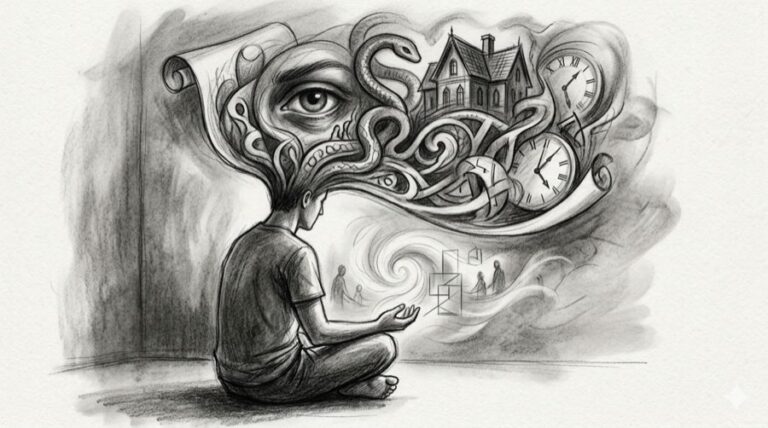
People sometimes ask me what happens in the brain during a QHHT session. They expect a complicated answer, but the short version is simple. The mind slows down into a specific electrical rhythm, and through that rhythm, parts of the self that usually stay in the background move into the foreground. That rhythm has a name. It is called theta.
- Theta brainwaves fall between four and eight hertz, slower than ordinary waking thought and faster than deep sleep
- This state occurs naturally just before sleep, in deep meditation, and during the middle phase of a well-guided hypnosis session
- In theta, the usual filter between the conscious and subconscious mind softens, allowing memories and insight to surface
- It is not a trance in the theatrical sense, but a relaxed, inward attention that the body already knows how to find
- Most people have been in theta many times in their lives without naming it, often in the quiet minutes between waking and sleeping
Where theta sits on the spectrum
Human brainwaves are usually described across five bands. Beta is the busy, task-focused daytime rhythm. Alpha is relaxed wakefulness, the state you might be in while reading quietly. Theta is slower still, and delta is the deep dreamless sleep below it. Gamma sits above beta, associated with high alertness and insight. A good overview of these states is kept by the National Institute of Neurological Disorders in the context of sleep research.
Theta is interesting because it is a threshold state. The conscious mind has quieted enough to stop narrating, but awareness has not disappeared into sleep. Something I often see is that clients describe this moment in almost identical language: they say they can hear me perfectly, they know where they are, but the weight of ordinary thinking has lifted.
Why the subconscious becomes more accessible
In ordinary waking life, the conscious mind acts like a gatekeeper. It sorts incoming information, defends old beliefs, and keeps emotional material at arm’s length. This is useful. Without it we would not be able to function at work or in traffic. But it also means the subconscious, which stores a much larger portion of who we are, remains largely out of reach.
When brain activity slows into theta, that gatekeeper loosens. Not because it is bypassed, but because it no longer feels the need to protect. In my experience, this softening is often accompanied by a subtle body change. Clients’ shoulders drop, the face relaxes, and breathing becomes deeper without instruction. It is as if the whole system acknowledges that it is safe to let go of holding.
What theta feels like from the inside
If you have ever woken up slowly on a Sunday morning and noticed the minute or two where thoughts feel soft and sensory at the same time, you have been in theta. Artists and composers often describe their most productive moments as happening in this exact state. It is associated with what researchers call hypnagogic imagery, the spontaneous visual and auditory impressions that arrive unbidden as the mind drifts.
During a session in my Laren practice, I guide clients into this state gradually. There is no dramatic moment of going under. Rather, the mind is invited to step down through alpha and into theta, and from there the work of the session begins. Clients who have experienced deep meditation recognise the territory immediately. Others are often surprised at how familiar it feels. I wrote more about this nightly version of the same state in a separate post.
Why insight surfaces in this state
One of the most striking things I notice with clients is how quickly insight appears once the brain settles into theta. Answers to questions they have held for years sometimes arrive in the first fifteen minutes. This is not because the mind suddenly becomes wiser. It is because the information was already there, held quietly by the subconscious, and the slowed rhythm has removed the noise that was covering it.
In my experience, the most common phrase clients use after a deep theta session is some version of, “I already knew this.” They do not feel that they have been told something new. They feel that they have finally been able to hear something they had been carrying. That distinction matters, because it shows how the state itself does the work. I have written about this quality of inner knowing as well.
Theta is a skill the body already has
Something worth saying clearly is that theta is not induced by hypnosis the way a drug induces a state. Hypnosis, especially the gentle form used in QHHT, creates the conditions for the brain to do what it already knows how to do. Every person who has ever fallen asleep has passed through theta on the way down, and through it again on the way back up. The practice in Laren simply invites the mind to stay there a little longer, and to use the opening.
For anyone curious about what this looks like in the context of an actual session, I have described the arc of one here. Understanding theta removes some of the mystery. What remains, once the science is clear, is the quieter and more interesting question of what you might hear in that state. That is the part each person answers for themselves, in their own time, in a room in Het Gooi with nothing pressing for attention outside.