Deep relaxation is one of those phrases that is easy to misunderstand. It sounds like something passive, almost a reward at the end of a long day. In fact, the physiological state it points to is specific, measurable, and foundational to every deep hypnotherapy session. The body does something quite particular when it relaxes deeply, and that something is what opens the door to the inner access a QHHT session depends on.
- Deep relaxation is a specific autonomic nervous system state, dominated by parasympathetic activity rather than the usual mixed sympathetic-parasympathetic balance
- It is marked by slowed breathing, lowered heart rate, increased heart rate variability, and a particular warmth and softness in the body
- This state reduces the brain’s scanning for threat, which is what allows attention to turn inward without resistance
- It is not the same as sleep, though it shares some features; the mind remains alert while the body releases vigilance
- Most adults do not spend much time in this state in ordinary life, which is part of why even brief sessions can feel so restorative
The autonomic nervous system in plain language
The autonomic nervous system regulates the background functions of the body that you do not have to think about: heartbeat, breathing, digestion, temperature regulation. It has two major branches. The sympathetic branch prepares the body for action and readiness. The parasympathetic branch supports rest, recovery, and the quiet processes of the body like digestion and repair. In ordinary life, both are running at varying levels all the time.
What deep relaxation does, physiologically, is shift the balance strongly toward the parasympathetic. This is sometimes called the rest and digest response, in contrast with the fight or flight response of heightened sympathetic activity. A readable overview is maintained by the National Library of Medicine. The parasympathetic shift is not mystical. It is a specific biological reconfiguration with specific effects.
What the body does
When the parasympathetic branch takes the lead, several things happen reliably. Breathing slows, often without deliberate effort. Heart rate drops by several beats per minute. Heart rate variability increases, which is a marker of healthy autonomic flexibility. Digestion quietly resumes. Blood flows more readily to the extremities, so hands and feet often warm. Muscles release holding patterns they have carried for hours or days without the mind noticing.
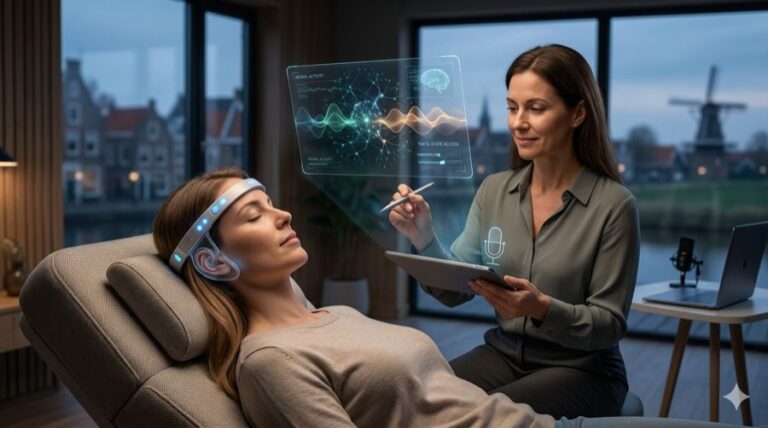
Something I often see in my Laren practice is that clients settle into this shift visibly within the first twenty minutes of a session. Their breathing lengthens. Their shoulders drop. The face softens in a way that is almost impossible to imitate consciously. These external signs are what practitioners in Dolores Cannon’s tradition watch for. They tell us that the autonomic reconfiguration has taken place, and the deeper work can begin.
Why the brain follows the body
Here is where it becomes interesting. The brain, reading the state of the body, stops scanning for threat as aggressively when the parasympathetic system is dominant. The dorsal anterior cingulate cortex, which I mentioned in the post on brain imaging, quietens when the body is relaxed. The default mode network, responsible for self-referential thinking and mind-wandering, loosens its grip. And the theta rhythm begins to emerge more steadily, which I have written about elsewhere.
The body is leading, and the brain is following. This is not the direction we usually imagine. In ordinary life, we think of the mind as directing the body. In deep relaxation, the brain takes its cues from the autonomic state, and the autonomic state opens inward access because the brain no longer has to attend outward as vigilantly.
What this means in the room
In my experience, the single biggest difference between a client who reaches deep QHHT state easily and one who struggles is how comfortable their autonomic nervous system is with parasympathetic dominance. Some clients arrive with bodies that have been running in near-constant sympathetic activation for months or years. For them, the first half hour of a session is primarily about convincing the body that it is safe to stand down. Once the body agrees, the mind drops in quickly.
Clients who have a practice of meditation, yoga nidra, or long periods of rest know this territory intuitively. Their bodies recognise the signals and settle more easily. Clients without such practices can still reach the state, but the drop-in takes longer. This is one reason QHHT is designed with such a long session window. There is time for the body to do its own work, without being hurried. I have written about this arc in more practical terms.
What a modern life usually lacks
Most adults do not spend much time in a clear parasympathetic-dominant state outside of sleep. The typical day is a low-grade mix of mild stress, task switching, and partial attention. Even quiet activities like watching television or scrolling often leave the nervous system in a subtle sympathetic hum. The body has not had a chance to fully let go of vigilance for hours, and often for days.
Something I often notice is that clients describe the first hour of a session as feeling strange in a good way. They often say they cannot remember the last time their body felt quite like this. They are describing the absence of background activation they had stopped noticing. The absence itself becomes information. They see, clearly, how much their body had been carrying.
Deep relaxation is the entry, not the destination
It is worth being clear that in QHHT, deep relaxation is not the point. It is the doorway. The work that happens once the door is open is different: exploration, communication with the Higher Self, attention to specific questions, integration of what arises. But without the doorway, none of the rest is available. Dolores Cannon’s description of the Higher Self presumes that the body has made itself available to be listened to.
For clients considering a session, this is the quiet reassurance worth carrying. You do not have to arrive in a deeply relaxed state. You have to arrive willing to let the state happen. The body knows how, and given enough time in the right environment, it will remember. A session in Het Gooi is long enough, and the landscape of Laren is quiet enough, that the autonomic shift comes on its own, which is exactly the way the method was designed to work.