Most of the preparation for a QHHT session happens in the final day and a half before it. But there is a quieter, longer preparation that begins about a week earlier, and the clients who do it arrive in a different state from those who do not. It is not a list of tasks. It is more like a slow tilting of the week toward the day itself. I want to describe what I usually ask for, so clients can give themselves the benefit of the longer window.
- Begin noticing your sleep, meals, and screen habits about a week before, without trying to change them yet
- Start drafting your list of questions over several days rather than in a single sitting
- Reduce caffeine and alcohol gradually from about four days before, so the body does not have to adjust abruptly
- Keep a small notebook near the bed for any dreams, images, or phrases that arrive during the week
- Protect your afternoon after the session by blocking it on your calendar a week ahead, so nothing can creep into that space
The week as observation
The first thing I ask is not to change anything in the first three or four days of the week. Simply notice. What time do you actually go to bed. How much caffeine you are having, and at what hours. How often you are on your phone in the last hour before sleep. What your meals look like. This observation, without intention to fix, is preparation in itself. It begins waking up the part of the mind that will later be doing the deeper observing during the session.
Something I often see is that clients who give themselves this noticing week arrive with much more accurate questions. They have seen their own patterns more clearly than before, and the list they bring reflects something they have actually looked at rather than something they assume they need to work on. This small shift changes the first hour of the session substantially. I have written about the day-of checklist separately.
Drafting questions over days
Instead of writing your list of questions the night before, begin it four or five days out. Keep it somewhere visible but not demanding. A single sheet of paper on a desk, or a note at the front of a journal. Add to it as things occur to you, cross out what no longer feels essential, and let the list evolve naturally. By the time the evening before the session arrives, you will have a list that has been through several rounds of your own judgement.
In my experience, questions that have been on the page for several days carry more weight than questions written in a single sitting. They have earned their place. They have survived your second and third thoughts. The subconscious notices this, and arrives at the session better prepared. I have also noticed that questions which feel urgent on day one often quietly retire by day five, and questions which had seemed small become the ones underlined.
Caffeine and alcohol, gradually
I do not ask clients to stop caffeine entirely before a session, but I do ask them to begin tapering from about four days before. Cutting from three cups to two, to one, to a single morning cup on the day before. The nervous system calms in a more stable way if the reduction is gradual rather than abrupt. Abrupt caffeine cessation itself can spike cortisol and leave the body in a subtly anxious state.
Alcohol is different. From three days before, I ask clients to skip it entirely. The effect of alcohol on theta activity and on deep sleep persists longer than most people realise, and a glass of wine three nights ago can still leave a subtle residue at the session. An overview of these neurochemical effects is available from the National Institute on Alcohol Abuse and Alcoholism for those curious about the underlying science.
A small notebook for dreams and images
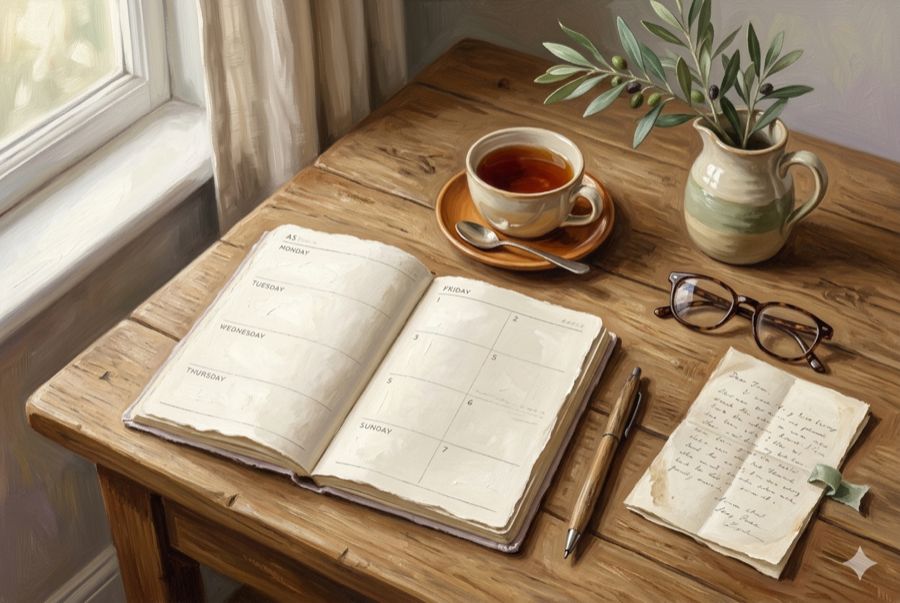
This is the suggestion clients are most often surprised by, and the one they most often thank me for afterwards. Keep a small notebook on your bedside table for the week before the session. Jot down any dreams, fragments, images, phrases, or recurring thoughts that arrive during the week. Do not interpret them. Do not try to remember them better. Just capture what shows up.
Something I notice is that the subconscious begins quietly rehearsing for the session about a week ahead. Material begins to surface in dreams, in half-waking moments, in odd associations during the day. Clients who write these fragments down arrive at the session with a sense of continuity. The session does not come out of nowhere. It comes out of a week that has already been speaking. I have written about this nightly processing in a related post.
Protect the afternoon after
A week ahead, while you still have your calendar in view, block the afternoon and evening following the session. Do it now. Do not trust yourself to remember closer to the date. Something I often see is that clients underestimate how strongly life tries to fill this space, and by the time they think to block it, a meeting or a family obligation has already slipped in.
The afternoon after is part of the work. I have written about what to do with those hours. Protecting them a week ahead is the single most practical thing you can do, and it is the one most often skipped. Treat it like a medical appointment. It is, in a real sense, a continuation of the session itself.
Travel arrangements, not on the day
If you are travelling to Laren from further afield, book your train or car arrangements by midweek. Do not leave this to the night before. The nervous system does not benefit from last-minute logistics. Clients who have already printed their tickets, checked the route, and confirmed their parking or taxi arrive on the morning of the session with nothing tactical left to worry about. I have written out the door-to-door route from Amsterdam Centraal if that helps.
The aim of the whole week is simple. By the time the morning of the session arrives, nothing in your outer life should require your active management. The day should feel protected, quiet, and already in motion. A session in Het Gooi deserves a week that has been quietly tilting toward it, so that when you arrive, you are simply continuing what the week has already begun.